If your outboard idles rough, hesitates under load, fouls a plug, or has quietly lost top-end, a fuel injector is a fair suspect. The symptoms alone, though, will not tell you whether the injectors are the actual cause. The same complaints come from a clogged injector, a dirty set, a tired fuel pump, or a cracked primer bulb pulling air. This article walks through what the symptoms mean, where else in the fuel system they come from, and how testing settles it.
What are the signs that a fuel injector is clogged or dirty?
Two failure modes account for most cases. Dirty shows up far more often than clogged at the bench.
- Clogged. Fuel is blocked to one cylinder by a deposit, debris, or a stuck pintle. Acute onset, usually isolated: a hard miss, a cold cylinder, hard starting, and a sharp drop in power.
- Dirty. Deposits distort the spray on every injector, so fuel still flows but flows badly. Gradual onset, usually the whole set: rough idle, weak top-end, and worsening fuel economy.
Here are the symptoms owners report most, and what each one tends to mean.
Rough running and rough idle
An injector delivering the wrong amount throws off the air-fuel balance in that cylinder. A mildly dirty set produces a slightly uneven idle that worsens over weeks. A clogged injector produces a pronounced miss, because a full cylinder is no longer pulling its weight. Brand-specific patterns, like Yamaha rough idle or OptiMax deposit buildup, carry their own tells.
A cold cylinder that is not firing
This is the clearest clogged-injector sign. If a cylinder gets no fuel, it does not combust. You can usually hear it at idle: the exhaust note skips a beat, and the engine shakes instead of holding steady. The live cylinders carry the weight of the dead one, and the shake develops a rhythm you can feel each time the firing order comes back around. Cylinder exhaust temps will confirm this. A dead cylinder points to a complete blockage, a stuck pintle, or an electrical fault on that one injector.
Insufficient power or a noticeable drop in power
A dirty set bleeds power gradually across the whole engine, because every cylinder is slightly underfed and poorly atomized. A clogged injector drops a chunk of power at once, because you have effectively lost a cylinder. Owners describe the first as the boat feeling tired, and the second as the boat falling on its face.
Hard starting
Cold starts demand precise fueling and good atomization. Dirty injectors that stream instead of mist make that harder, especially first thing in the morning. A clogged injector means a cylinder contributes nothing during cranking, so the engine has to catch on the rest. Extended cranking is a fueling-quality signal once ignition and battery health are ruled out.
Excessive exhaust smoke
Read the smoke. Black smoke and a strong fuel smell point to a rich condition, the signature of a leaking or stuck-open injector, not a clogged one. A clogged or severely dirty injector pushes the cylinder lean, which shows up as a miss or weak combustion rather than smoke. Smoke gets blamed on clogging when the real fault is usually a leaking or stuck-open injector.
Poor fuel economy
A poorly atomized charge burns less completely, and the engine management compensates by adding fuel. You work harder for the same speed and burn more to get there. A measurable drop in economy with no change in load or conditions is one of the earliest signs the injector set needs attention.
Dirty, clogged, or stuck open
Three failure modes sit behind those symptoms.
- Dirty. The injector still flows fuel, but flows it badly. Deposits on the pintle, seat, and spray tip distort the spray into a stream or dribble. Gradual onset, usually the whole set, since every injector sees the same fuel.
- Clogged. The injector is restricted or fully blocked by a deposit, debris, or a stuck pintle, so its cylinder runs very lean or stops firing. Acute onset, usually isolated to one injector.
- Stuck open or leaking. The injector dumps too much fuel, so that cylinder runs rich. Acute onset, usually isolated to one injector.
Different injector designs deposit differently across the pintle, seat, and spray tip. Regardless of the condition, the injectors still need to come off the engine and go on the bench to dial them in.
It is not always the injector
The injector sits at the end of a chain. Several parts upstream throw the same symptoms, and a symptom alone cannot tell you which part is at fault. The numbered markers on the diagram match the list below.
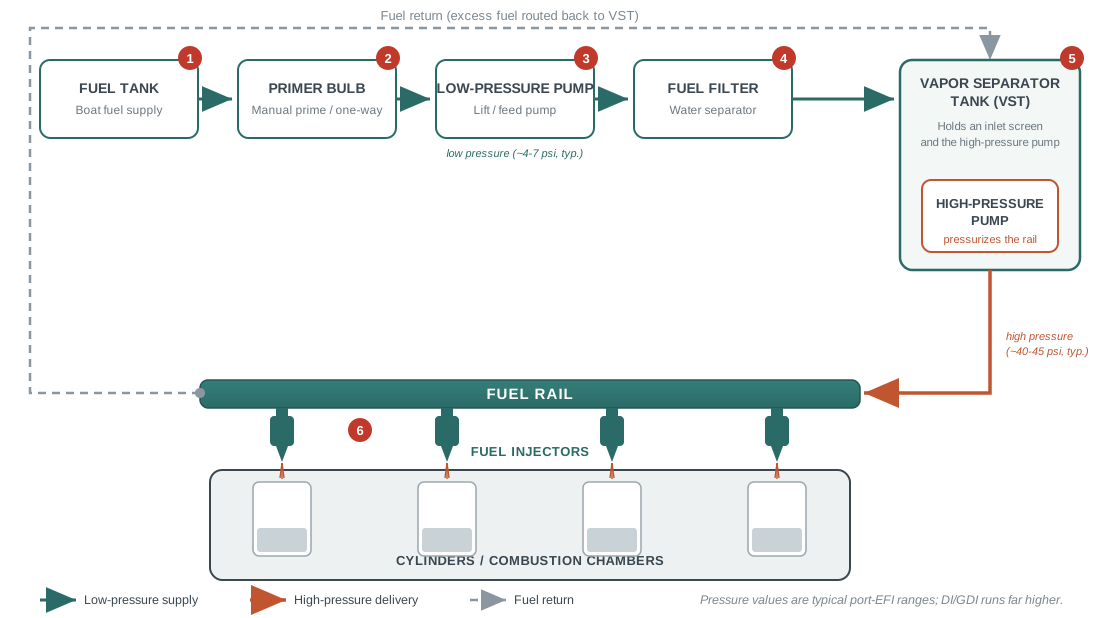
- Fuel tank. Sediment and water settle out, and ethanol fuel can phase-separate. A clogged pickup screen starves the feed.
- Primer bulb. Hairline cracks and tired check valves draw air into the system, causing lost prime, hard starts, and lean running.
- Low-pressure pump. A torn or ruptured diaphragm cuts feed pressure and volume — sometimes all at once, sometimes a pinhole that only shows under load, so the engine idles fine and bogs at wide-open throttle. The pump can also weep fuel externally.
- Fuel filter. A dirty or water-logged element restricts flow. Note that the VST carries a second inlet screen that also clogs.
- Vapor separator tank. The pump-inlet screen clogs and water collects. A worn high-pressure pump drops rail pressure across the whole set.
- Fuel injectors. Deposits distort the spray when dirty. Debris or a stuck pintle blocks flow when clogged. A stuck-open injector leaks and runs rich.
When the bench says it is not the injectors
A twin-rigged customer came to us with two Yamaha 150 OX66 outboards that were not running the way they should, and we put both sets on the flow bench.
The numbers came back mostly healthy. On each engine, one cylinder was reading high before cleaning, 510 and 504 cc/min against a set average near 487, with a few injectors showing fair spray and slight asymmetry. Cleaning corrected the high cylinder back into the pack on both engines. The sets finished at 2.4 percent variance and 1.2 percent variance, respectively. Good improvements, preventative maintenance done, but not the smoking gun we were hoping for.
That result was the useful part for the next conversation. The injectors were now dialed in, but we wanted to check a couple more problem areas before the owner took it back out on the water. We asked the owner to look at the low-pressure fuel pumps, because those diaphragms can also go bad. Sure enough, the owner found a bad one on one engine, and now the boat runs fantastic.
When the bench says it is the injectors
The other end of the spectrum: a boat that had sat for two years came in dead. On the bench, two of its six injectors were fully clogged and did not spray, and the other four injectors had poor spray patterns. No amount of fresh fuel or cranking was going to bring those cylinders back, because the fuel could not physically reach them. We cleaned and tested the set, the two blocked injectors came back to spec, and all six showed great atomization in their spray patterns after service.
Same tool, different answers. One boat needed work the injectors were not responsible for. The other would not have run until the injectors were serviced. The symptoms combined with the bench results told us what to do next. If you are wondering what a job like this costs, see our pricing breakdown. If you want yours dialed in, we'll send them back ready to install.
Where the maintenance schedule stops
Here is the gap worth understanding. Yamaha builds its service schedule around 20, 100, 300, and 500 hour intervals, and the fuel-system items on that schedule are the fuel-water separating filter and, deeper in, the VST filters and tank gasket, along with inspection. Yamaha even notes that different fuel can call for more frequent fuel-system service. What the published schedule does not include is any procedure to verify what your injectors are actually flowing once they are in service. It replaces filters and assumes the injectors still deliver to spec. It never checks.
The ECU does not fill that gap either. It commands each injector from a fuel map and a few sensor inputs, and assumes the injector delivered what was asked. There is no per-cylinder feedback that confirms the result. The computer can also read the engine wrong: a leaking injector may make the whole exhaust read rich, and the ECU responds by leaning out the entire set; a flooded cylinder that is misfiring may even get more fuel on the next pulse if the ECU reads the missed combustion as a lean event. Either way, the computer is working from the map and the sensors, not from what each injector is actually spraying.
Deposits build gradually. A 2015 review in Progress in Energy and Combustion Science reports a 23.5 percent injector flow-rate loss from fouling in a controlled dirty-up test, with fuel consumption climbing alongside it. Pour-in additives help with mild buildup but have a ceiling, and they cannot recover a badly fouled or blocked injector. Removing the injectors for ultrasonic cleaning and bench testing is what restores flow and spray pattern to specification, and it is the only way to confirm the set is actually balanced. The industry reference points are not ours alone: OEM injectors are built to flow within roughly 2 percent of each other, and a serviceable set is generally held within about 5 percent.
So off-engine cleaning and testing is not a number Yamaha prints in the manual. It is the verification the manual leaves out. A rough-running motor that passed every scheduled service can still carry an injector problem the schedule never told anyone to look for.
How to tell which it is
The pattern is a starting point. Gradual, engine-wide complaints and a tired feel lean toward a dirty set. A sudden dead cylinder, a hard miss, or rich smoke leans toward a single injector that is blocked, stuck, or leaking. Pattern recognition narrows the field, but it does not confirm anything. Both of the jobs above looked like injector problems from the helm.
Suddenness alone can mislead. A failing low-pressure pump can feel acute too — fine at idle, falling on its face when demand outruns supply at wide-open throttle. The tell is isolation, not onset: starvation bogs the whole engine under load, while a clogged injector takes one cylinder out at every load.
Flow testing is what turns the symptom into a number. We measure what each injector actually delivers at a set pressure and pulse, watch its spray pattern, and compare the set to itself and to spec. That tells us what to clean, what to replace, and, just as often, whether the injectors are even the problem. Either way the injectors come out and go on the bench, because that is the only way to separate a clogged injector from a tired pump, a dirty set from a cracked primer bulb.
This article describes general EFI outboard behavior across common brands, and the example jobs are real Dialed Injectors service work with customer details removed. Exact fuel-system layout, test pressures, and service intervals vary by engine, so treat the pressure figures in the diagram as typical port-injection ranges and refer to your engine's manual for its schedule. Direct-injection and GDI systems run far higher pressures.