If you have ever watched a flow bench video, ours or somebody else's, the setup looks straightforward enough at first. Each injector pulses fuel into its own glass beaker, and as the test runs the beakers fill up, and that is more or less the whole show.
The part that does not get explained on most videos is that those beakers are standing in for the cylinders in your engine. The amount of fuel each one receives across the test is exactly the amount of fuel its matching cylinder is going to receive in your boat or your truck, across every duty cycle from idle up to wide open throttle. That is as true for a pickup as it is for an outboard, which is why the same bench runs our automotive fuel injector cleaning and flow testing service.
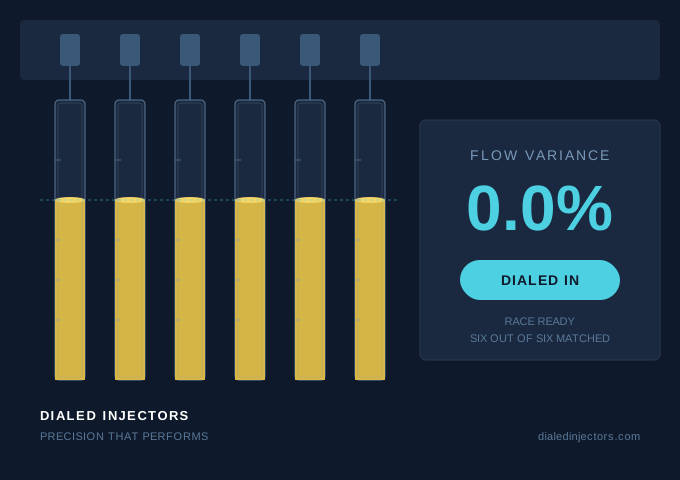
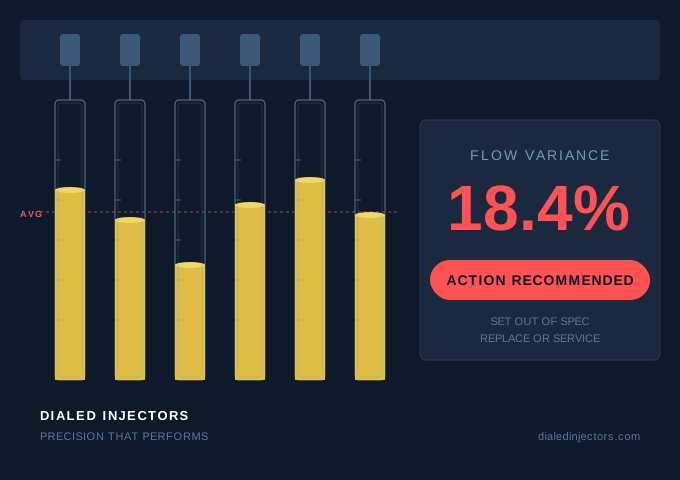
Every beaker fills at the rate of one injector spraying for a set number of pulses at a known pressure (typically three bars, or about 43.5 psi). If beaker three sits lower than beaker four when the test is done, that means cylinder three is being starved compared to cylinder four. That is exactly the situation flow testing exists to catch. A clean injector running inside OEM spec should be putting the same amount of fuel into its cylinder as every other injector on the rail, every single pulse, for thousands of hours. When one drifts, your engine starts running on a fuel curve that no longer matches what the ECU thinks is happening.
Why even fuel distribution matters
Every modern fuel injection system is built around an assumption that becomes invisible once the engine is running: each injector will deliver the same amount of fuel as the others, every single pulse, forever. The ECU does not verify this. It cannot. It sends out a pulse command (open for 3.2 milliseconds, say) and trusts that the injectors will do what they did the last million times they were asked.
When an injector gets dirty, or worn, or sticks open or closed, there is no feedback loop back to the ECU saying so. Your engine ends up with cylinders running on different air-fuel ratios, and from the driver's seat (or the helm) it might just feel like a rough idle, or hesitation under load, or maybe a check engine light a few weeks down the road. Those are the classic symptoms of a dirty or clogged injector, and the damage inside the cylinder is already underway by the time any of them show up.
The numbers: cc/min vs lb/hr
Here is where the conversation tends to fork. Marine guys and automotive guys talk about injector flow in different units, and depending on which side you came up on, one of them feels natural and the other looks like math homework.
cc/min is short for cubic centimeters per minute. It is a volume measurement, and it is what we read directly off the beakers on the bench. You can watch the number go up in real time, because what you are looking at is the actual liquid the injector pushed out.
lb/hr stands for pounds per hour, and it is a weight measurement instead of a volume one. Your tuner thinks in lb/hr. So does your ECU calibration. So does the dyno sheet you got back the last time you put the engine on the rollers.
Both of them describe the exact same flow rate, the way miles per hour and kilometers per hour describe the same speed. The conversion for pump gasoline at the standard 43.5 psi test pressure is:
lb/hr × 10.5 ≈ cc/min
Or going the other direction: cc/min ÷ 10.5 ≈ lb/hr
So your 24 lb/hr injector is doing roughly 252 cc/min on our bench, and a 550 cc/min injector reads out as about 52 lb/hr on a dyno sheet. If you are running E85 the multiplier shifts because ethanol is denser than gasoline, but the math is the same, just with a different number plugged in. Type a number into either box below and the other side fills in, both directions, E85 included.
Flow converter
The reason the two languages exist is mostly historical. Marine and European tuning came up on cc/min because that is what the flow benches displayed. American automotive tuning standardized on lb/hr because that was the unit the fuel maps were originally built in. Any serious tuner today works in both, but if you can do the conversion in your head you can sanity check the numbers on your diagnostic report against whatever your tuner or your service manual is telling you.
What actually happens when an injector flows wrong
All of that math eventually matters because variance has real consequences.
Running lean is when a cylinder receives less fuel than the ECU is asking for. The air-fuel ratio climbs, combustion temperature climbs with it, and under load that cylinder can start to detonate. Sustained detonation will crack a ring land, burn an exhaust valve, and in the worst cases melt a piston crown clean through. On a four-stroke outboard you usually cannot hear detonation over the engine itself, so by the time something fails audibly, the damage is already done and the repair is already expensive.
The opposite problem, running rich, is just as expensive over time even though it looks less dramatic. Too much fuel washes oil off the cylinder walls, the rings and bore wear faster as a result, and whatever fuel does not burn ends up in the crankcase diluting the engine oil. Spark plugs foul. On a two-stroke, a rich cylinder can foul so fast that it floods out entirely before you make it back to the dock.
I learned this one the hard way on my own outboard. One of the injectors was flowing well outside spec, the cylinder was already in flooding stage by the time I caught it, and after I replaced it my overall fuel economy came back up by twenty percent.
How flow testing prevents it
A diagnostic flow test is the only way to get real numbers on any of this. Here is what we actually measure:
- Actual flow on every injector at the same pressure, temperature, and pulse width, so each injector in the set is being measured under identical conditions and the readings can be directly compared.
- Set variance between the highest-flowing and lowest-flowing injectors in the group. Tight variance means a balanced set. Wide variance means at least one injector is off and the engine is no longer running the fuel curve the ECU thinks it is running.
- Comparison to OEM spec where we have it, which tells us whether the whole set has drifted together over time, or whether one or two outliers are dragging the group away from where it should be.
When your diagnostic report shows up in your inbox, the cc/min column is the raw measurement and the variance percentage is what that measurement adds up to. The status badge at the top of the report just translates the math into plain English: dialed in, monitor, or take action. Those same numbers are the difference between an engine that runs the way the factory designed it and an engine that is quietly cooking a cylinder while you trailer the boat home.
The same logic, taken to its extreme, is how race teams build matched sets. A serious team will flow test twelve, sixteen, sometimes eighteen injectors and pull the eight (or six, or four) that are tightest to each other. When tenths of a second matter, you do not want one cylinder making more power than the others.
The bench catches the drift, but fuel quality sets how fast deposits build in the first place. Running Top Tier gasoline slows the buildup between services.
Matched is not the same as in spec
Everything above is about injectors matching each other. That is one question, and it is the one most people stop at. There is a second question that matters just as much: is the set actually hitting the flow it is rated for? Every injector has a target number, a rated flow in cc/min or lb/hr at the test pressure, and those numbers vary widely between families. One family is built to flow 250 cc/min. Another is built for 350. Same job on a different engine, different target.
Here is the trap. A set can read tight to itself and still be wrong. We have pulled sets off the bench that sat within a couple of percent of each other but a uniform ten percent below their rated flow. Every cylinder was getting the same amount of fuel, so the engine idled smooth and felt balanced, and nothing about the way it ran pointed at fuel. But the whole set was delivering less than the calibration is built around, which means every cylinder was running leaner than the factory intended, all at once. Variance testing would never flag it, because the variance was fine. The set was matched. It was just matched to the wrong number.
The harder part is knowing the target in the first place. The rated flow for a specific marine injector is often not printed in the owner's manual, and frequently not in the service manual either. Injector platforms get second-sourced and tailored per application, so two injectors that look like the same family can be calibrated to different flows for different motors. We had a set that every cross-reference said should flow 235 cc/min. It came off the bench at 195, and it would not move after two full cleanings. That told us the injectors were not dirty. They were built to a lower flow on purpose, spec'd down for a smaller outboard, and the 235 figure we could look up simply was not their number. They were performing exactly to their real spec. The spec on paper was wrong.
That is why the bench is sometimes the only honest source for a flow rate. When the published figure is missing, generic, or carried over from a different application, the delivery we measure under controlled pressure and pulse is the real number. The test answers both questions at once: whether the set is matched to itself, and whether it is hitting what it is supposed to. One without the other is half an answer.
A quick note on the illustrations above. Both ends of the spectrum shown are deliberate extremes used to make the point readable at a glance. In the real world you will almost never see a flat 0.0% variance, and an 18.4% spread is also pretty rare. Most diagnostic reports land somewhere in between, and that middle is exactly where the "dialed in" versus "monitor" versus "take action" call gets made.